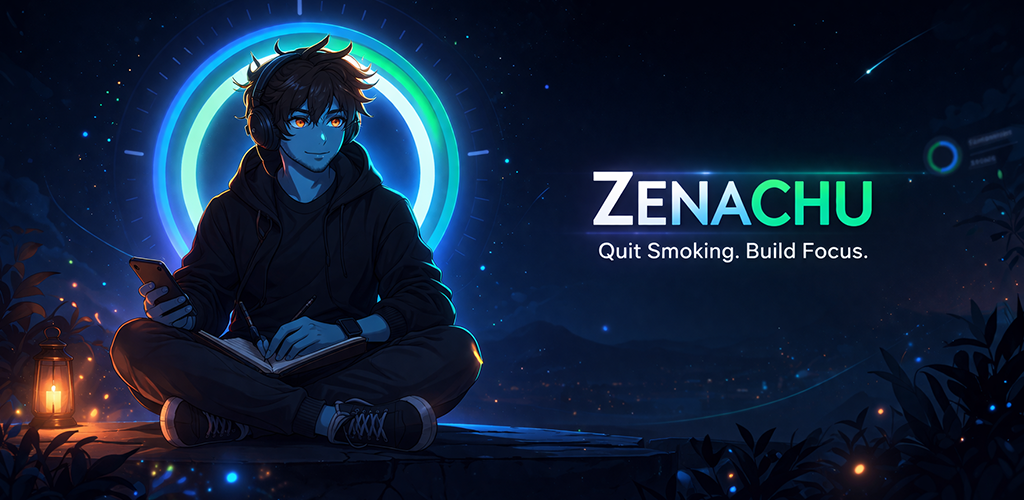
Learn more and join the waitlist at zenachu.com
Visit zenachu.comI built a lo-fi music app because I wanted something calm to listen to while studying. I didn't plan to build a habit tracker. I definitely didn't plan to build an addiction recovery tool with a fidget spinner. But that's what happened.
Zenachu started in early 2025 as a simple idea -- a curated lo-fi music player. Eight moods. Fifty tracks. Press play, pick a vibe, and focus. Calm, Energetic, Focus, Cozy, Dreamy, Coffee, Rain, Nature. Each mood had its own gradient, its own feel. The tech was straightforward: Expo, React Native, Firebase for auth, Cloudflare R2 for streaming the tracks. I hand-picked every song. The player worked. The vibes were right. That should have been the end of it.
People don't just listen to lo-fi for the music. They listen to it because they're trying to focus. Trying to calm down. Trying to get through something. The music was the surface -- underneath, there was always a need.
First came the timer. A simple focus/meditation timer that paired with the music. Then came the journal -- free-form daily entries with time-based prompts. Then habits: Keep, Grow, Let Go. Three categories for three types of change. Each feature felt like it belonged. It was all one experience: sit down, put on your headphones, and take care of yourself.
The real shift happened when I built the Let Go tracker. It started as a simple quit-date counter -- days clean, hours, minutes. But I wanted something physical. Something you could do with your hands when a craving hit instead of reaching for the thing you're trying to quit.
So I built a bezel spinner. An interactive fidget wheel right on the tracking screen. You spin it with your thumb. It tracks your rotation distance. It gives you encouragement messages while you spin -- context-aware, based on your streak, your template, the time of day. Every spin is proof you fought back.
“It sounds small. But for someone at 2 AM fighting a craving, having something to do with their fingers changes everything.”
Smoking. Vaping. Alcohol. Doom Scrolling. Junk Food. Gaming. Caffeine. Cannabis. Each template has its own health timeline. Each has craving messages written specifically for that struggle. Users can track multiple addictions simultaneously. The app detects danger hours -- times of day when cravings historically spike -- and warns you before they hit.
Quitting something isn't just about stopping. It's about replacing. When a craving hits, the app suggests a replacement activity from six categories: Physical, Creative, Social, Calm, Learn, Fun. You log the swap, rate how you felt after, and build a score over time. You're not just breaking a habit, you're building a new one.
What makes Zenachu different from a meditation app or a habit tracker or a music player is that it's all of them at once, and they all talk to each other. Your journal prompts change based on your Let Go template. Your wisdom quotes filter to match your recovery stage. The music is always there underneath. Nothing is isolated. Everything is one calm, connected experience.
I wanted the app to feel like 2 AM with headphones on. Dark backgrounds. Frosted glass overlays. Mood-mapped colors. An animated Zen Character that walks, listens, reads, naps, and drinks coffee depending on context. The design isn't flashy. It's warm. Recovery shouldn't feel clinical. It should feel like your favorite playlist.
Zenachu is in active testing. The core is built: lo-fi library, multi-tracker Let Go system, fidget bezel, craving game, habits, journal, daily check-in, missions, zen challenges, video diary, wisdom quotes, swap system, app lock, smart prompts, and Android home screen widgets. The plan is to ship to the App Store and Google Play in Q2 2026.
I started building a lo-fi player. I ended up building something I needed more than I realized. And if it helps one person spin a fidget wheel instead of reaching for a cigarette at 2 AM, it was worth every line of code.